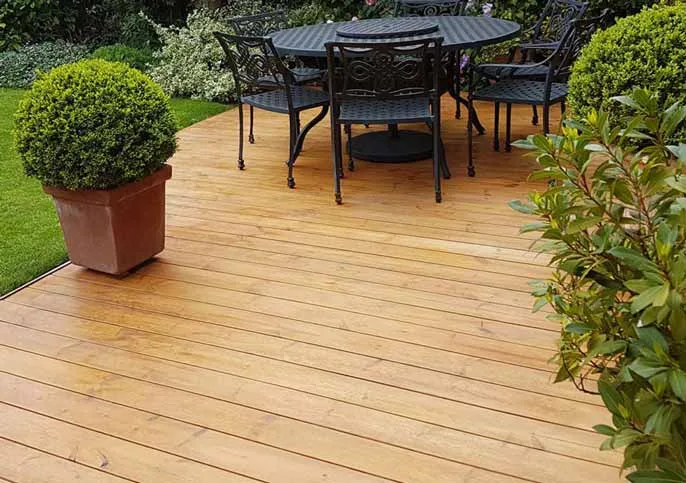
Most of the early failures we see on site come from installation, not material. Three details decide whether a deck lasts ten years or three.
Ventilation underneath
The underside of the board has to breathe as freely as the face. Leave at least 30–40 mm of clear air below the joists, and make sure both ends of that void are open. A void closed at one end does not ventilate: it traps moisture and rots the board from below.
Joint width
The gap between boards is both drainage and expansion allowance. On kiln-dried hardwood, 5–8 mm is right. If the timber is wet at installation, work to the lower figure; if it is dry, work to the upper one: the board will take up moisture and expand.
Fixings
Use nothing but stainless steel: A2, or A4 near the coast. Galvanised coatings react with the tannin in hardwood and leave permanent black staining around every screw. Fix each board with two screws at every joist, and pre-drill.
Board direction and end grain
End grain is the thirstiest surface on the board. Seal every cut end with an end-grain sealer. Lay boards parallel to the fall so water runs off rather than ponding.